Home / Combinatorics & Counting
Permutations vs Combinations: Why Order Changes Everything in Probability
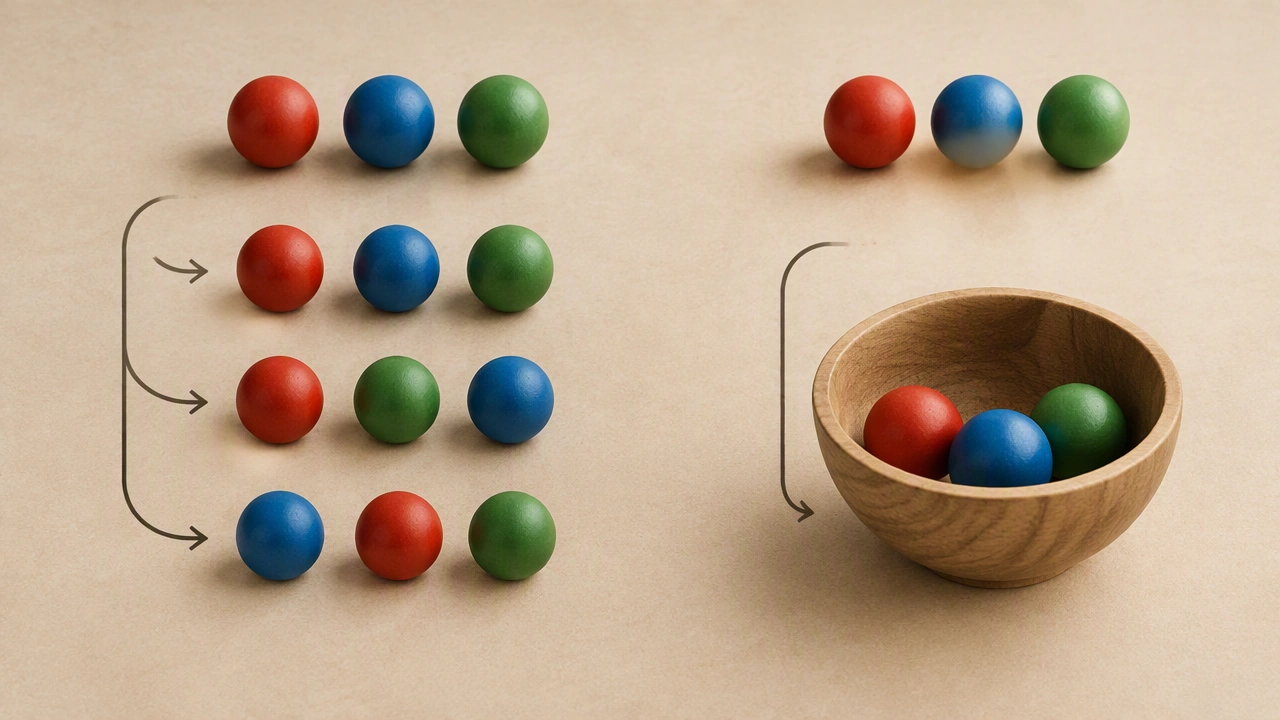
When people first encounter probability and the mathematics of chance, one of the earliest stumbling blocks is knowing whether the order of items matters. Two closely related counting methods — permutations and combinations — look similar on the surface but produce very different results. Understanding the difference between permutations and combinations with examples is not just an academic exercise; it is the foundation for correctly calculating probabilities in fields ranging from genetics to computer science to everyday decision-making.
This article clarifies what makes these two methods distinct, when each one applies, and how confusing them leads to incorrect conclusions.
What Is a Permutation?
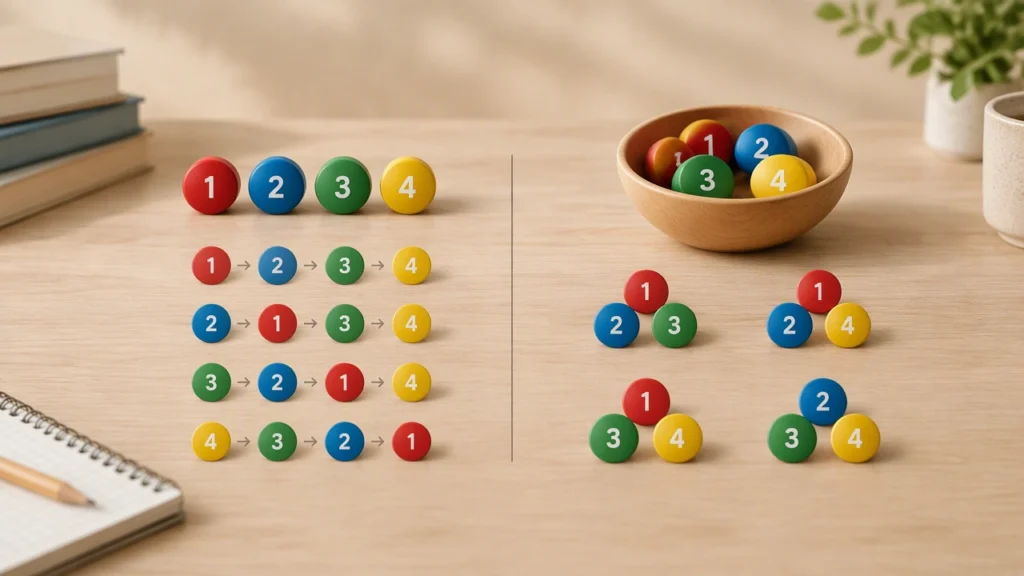
A permutation is an arrangement of objects in which order matters. If you change the sequence, you get a different permutation. The classic illustration is a three-digit lock code using the digits 1, 2, and 3 without repetition. The arrangement 1-2-3 opens the lock, but 3-2-1 does not. Each distinct ordering is a separate permutation.
Mathematically, the number of permutations of n distinct objects taken r at a time is:
P(n, r) = n! / (n − r)!
For example, if you want to arrange 3 books on a shelf from a collection of 5, you calculate P(5, 3) = 5! / 2! = 60 possible arrangements. The first book you place has 5 choices, the second has 4, and the third has 3 — giving 5 × 4 × 3 = 60.
What Is a Combination?
A combination is a selection of objects in which order does not matter. The group {A, B, C} is the same combination as {C, B, A} because both contain the same three elements. Only the membership of the group counts, not the sequence in which items are listed.
The number of combinations of n distinct objects taken r at a time is:
C(n, r) = n! / [r! × (n − r)!]
Notice the extra r! in the denominator. That term exists precisely to remove the duplicates created by different orderings of the same group. If you want to choose 3 books from 5 to carry in a bag (with no concern for arrangement), you calculate C(5, 3) = 10 possible groups.
Why the Distinction Matters
The relationship between the two formulas is straightforward: every combination of r objects corresponds to r! different permutations of those same objects. Dividing by r! converts a permutation count into a combination count. This is not merely a bookkeeping trick — it reflects a genuine difference in what question you are asking.
Ask yourself: does swapping two items produce a new outcome? If yes, you need permutations. If no, you need combinations. Getting this wrong doubles, triples, or further inflates your count and leads to probability estimates that are far off the mark.
Worked Examples
Example 1: Selecting a Committee
A club has 8 members and needs to choose a committee of 3. Does the order of selection matter? No — a committee of Alice, Bob, and Carol is the same as one of Carol, Alice, and Bob. You use combinations:
C(8, 3) = 8! / (3! × 5!) = 56 possible committees.
Example 2: Assigning Roles
Now suppose the same club must choose a president, a vice-president, and a treasurer from its 8 members. Here order absolutely matters because each position is distinct. Alice as president and Bob as vice-president is a different outcome than Bob as president and Alice as vice-president. You use permutations:
P(8, 3) = 8! / 5! = 336 possible assignments.
The same 8 people, the same number 3 — yet the answers differ by a factor of 6, which is exactly 3!.
Example 3: A Lottery-Style Drawing
Six numbers are drawn from a pool of 49, and the order in which they appear is recorded. If the sequence matters, there are P(49, 6) ≈ 10 billion possible outcomes. If only the final set of six numbers matters (as in many real drawings), there are C(49, 6) ≈ 14 million possible outcomes. The difference is enormous and illustrates how a single assumption about order changes the probability landscape.
Common Pitfalls
- Assuming order never matters. Many beginners default to combinations because the word “choose” feels order-free. But if the result is a sequence, a ranking, or an assignment to distinct positions, order matters.
- Forgetting to divide by r!. When converting from permutations to combinations, omitting the division by r! inflates the count and deflates each event’s calculated probability.
- Ignoring repetition. Both formulas above assume no repetition. When items can be reused (such as a PIN where digits may repeat), different formulas apply, and the permutation-versus-combinations distinction still plays a role but in a modified form.
A Quick Decision Framework
Before calculating, run through these questions:
- Am I arranging items in a sequence or assigning them to distinct positions? → Use permutations.
- Am I forming a group where only membership matters? → Use combinations.
- Am I unsure? → Try a small case by hand. List every outcome and check whether swapping two items creates something new. The result will tell you which method to apply.
Conclusion
Permutations and combinations are two sides of the same counting coin, separated by a single question: does order matter? Mastering this distinction is essential for anyone studying probability, statistics, or discrete mathematics. The formulas are simple, but choosing the right one requires careful thinking about what the problem is actually asking. By consistently identifying whether you are counting arrangements or selections, you avoid a common and costly error — and you build the intuition that makes more advanced probability work feel natural rather than mysterious.