Home / Real-World Applications
How Scientists Use Probability to Model Unpredictable Events in Nature
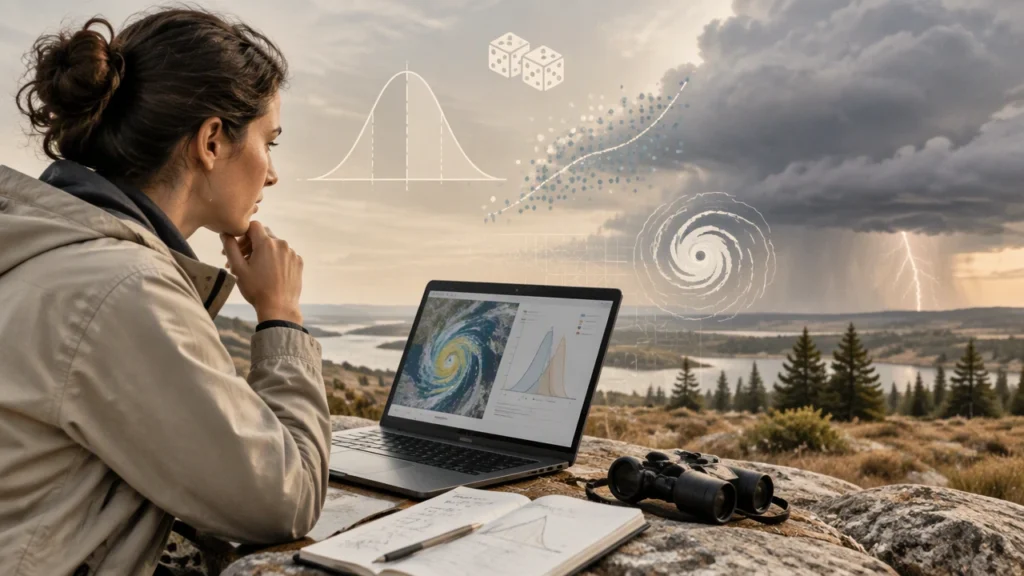
Probability is the mathematics of uncertainty. It gives scientists a precise language for describing events that cannot be predicted with certainty, while still revealing patterns that emerge across many trials. From the way genes change to the movement of storms, probability is used to model natural phenomena that are too complex, noisy, or inherently random to forecast exactly.
What probability measures
At its simplest, a probability is a number between 0 and 1 that describes how likely an event is under a specified model. A value near 0 means the event is rare in that model; a value near 1 means it is common. The crucial phrase is under a specified model. Probability does not float free of assumptions. It depends on what counts as an event, what information is available, and how the system is represented.
Scientists distinguish between two broad sources of uncertainty. Aleatory uncertainty comes from genuine variability, such as the timing of radioactive decay or the tiny molecular motions that influence a seed’s orientation. Epistemic uncertainty comes from incomplete knowledge, such as unknown soil moisture across a landscape. Some systems contain both. Probability models help separate what we cannot know exactly from what we might learn with better measurements.
Mutations: change as a random walk
DNA mutations are a classic example. A mutation is a change in the nucleotide sequence of a genome. Some changes are caused by chemical damage, copying errors during cell division, or exposure to radiation. At the level of an individual site, the timing and nature of a mutation may be difficult to predict, so biologists treat mutation as a stochastic process: a random process with defined statistical properties.
Probability lets researchers ask several kinds of questions. How likely is a particular substitution in one generation? If a new variant appears, what is the chance it disappears quickly versus increasing in frequency? How does population size alter those chances? Simple models, such as random genetic drift, show that even without any selective advantage, allele frequencies can change over time because each generation is a finite sample of the previous one. The mathematics turns vague intuition about chance into testable predictions.
Mutation models also account for structure. Not all DNA positions mutate at the same rate, and some changes are more likely than others because of chemical similarity. A model might assign different probabilities to transitions and transversions, or include neighboring bases that influence local error rates. These details matter when scientists estimate mutation rates from genomic data or reconstruct evolutionary histories. The goal is not to claim that any one mutation was inevitable, but to describe the ensemble of possible outcomes and the frequencies expected across many sites or lineages.
Weather: ensembles, not single futures
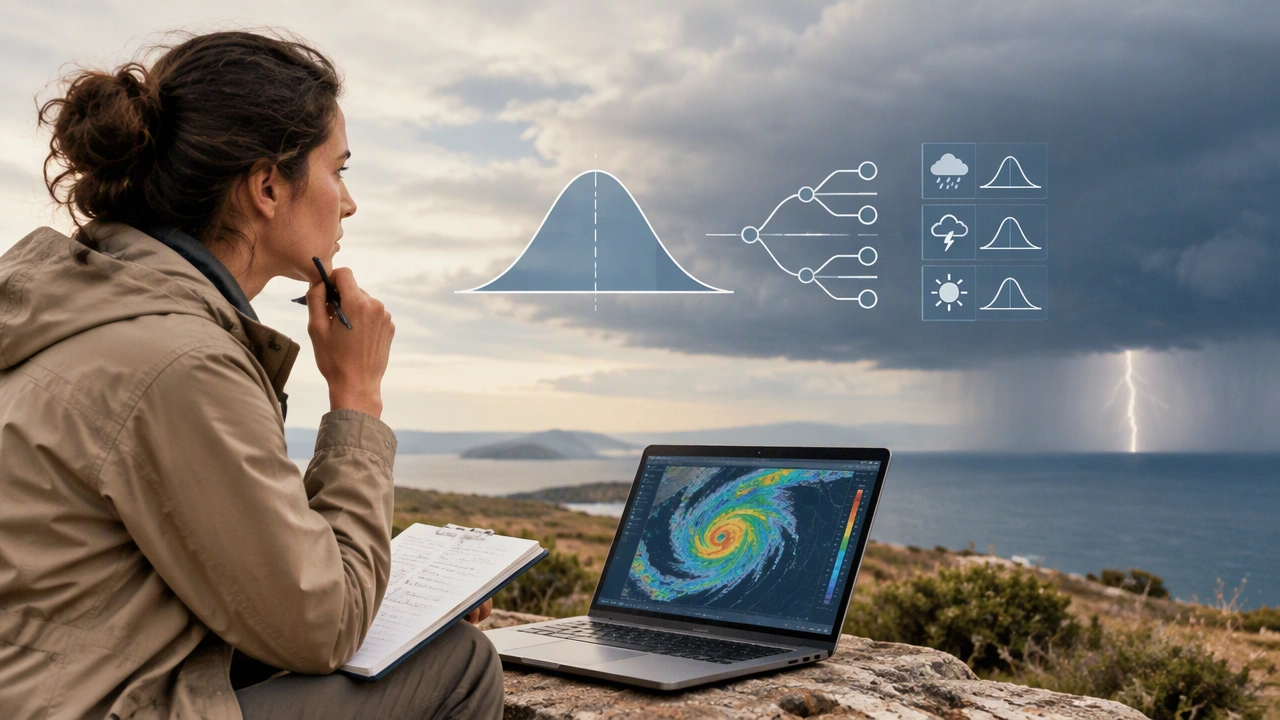
Weather forecasting faces a different kind of randomness. The atmosphere is a chaotic fluid system: small differences in initial conditions can grow rapidly, making exact long-range predictions impossible. Even with perfect equations, tiny measurement errors can lead to different outcomes. Probability enters through ensemble forecasting. Instead of producing one deterministic forecast, a modeling center runs many simulations with slightly different initial conditions and physics settings. The spread among those simulations estimates the likelihood of various outcomes.
Suppose an ensemble contains 50 forecasts. If 40 of them show rain over a city tomorrow, the raw proportion, 40/50, is a simple probability estimate, though forecasters usually calibrate it against past performance. Calibration matters because a stated 70% chance of rain should correspond to rain occurring in roughly 70% of comparable situations over the long run. Probability therefore connects model output to observed frequencies.
Ensembles also help quantify uncertainty in extremes. Predicting whether a storm will cross a particular coastline involves both the path and intensity of the system. Some members may curve out to sea while others make landfall. The fraction of members in each category provides a probabilistic picture, which is more informative than a single line on a map. People planning around weather often need ranges and chances, not just a best guess.
From local randomness to population patterns
Probability scales from single events to large patterns. In epidemiology, the spread of an infection depends on contact networks, viral variation, and individual behavior. Stochastic models simulate these processes to estimate outbreak probabilities and the chance that an introduction dies out before spreading. In ecology, chance affects which seeds arrive at a patch, which seedlings survive a drought, and how quickly a population recovers after disturbance.
Climate science uses probability in a complementary way. Rather than asking whether a single hot day is caused by climate change, researchers compare the frequency of such days in worlds with and without human influence. Large ensembles of climate simulations estimate how the odds have shifted. This approach, often called attribution science, focuses on changes in distributions rather than the fate of one event.
Why models can be useful without being certain
A common misunderstanding is that probability models promise certainty. They do the opposite: they make uncertainty explicit. A model is useful when its assumptions are transparent, its predictions can be checked, and its limitations are acknowledged. Validation often involves comparing predicted frequencies with observed frequencies over many cases. If the match is poor, scientists revise the model or narrow the scope of its claims.
Probability also supports decision-making under uncertainty. Public agencies may use forecast probabilities to stage equipment before a storm, while conservation managers may use mutation and population models to assess long-term risks. The same mathematics can guide preparedness without implying that outcomes are guaranteed.
The deeper idea
Randomness in nature does not mean that nothing can be known. It means that knowledge often takes the form of patterns, rates, and chances rather than fixed trajectories. Probability provides the tools to express those patterns, compare competing explanations, and communicate uncertainty clearly. Whether scientists are tracing the emergence of a genetic variant or mapping the possible paths of a storm, they are using probability to turn unpredictable events into questions that mathematics can answer.