
Home / Fundamentals of Probability
The Gambler’s Fallacy Explained: Probability and Why the Past Does Not Control the Next Independent Event
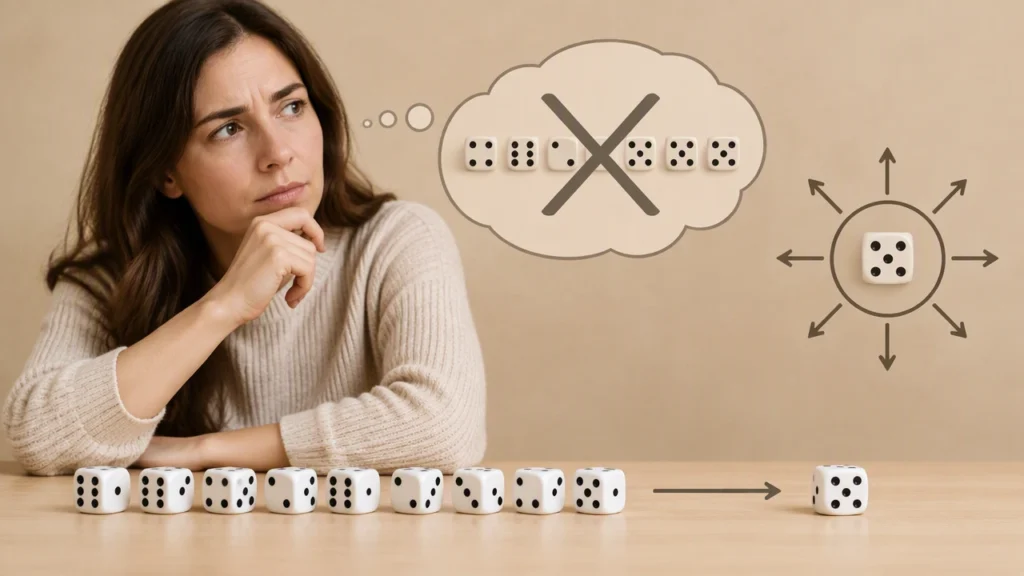
In everyday life, patterns feel powerful. When a coin lands heads several times in a row, many people expect tails to appear next. This belief has a name: the gambler’s fallacy. It is the mistaken idea that past random events do affect future independent outcomes, as if chance carries a memory that tries to balance itself. In reality, probability is a tool for describing long-run behavior, not a force that corrects the past. Understanding this distinction is central to mastering the fundamentals of chance.
What probability actually measures
Probability assigns numbers to uncertainty. A fair coin has a 1/2 chance of heads on any single toss because the physical setup is symmetric and there is no reason to prefer one outcome over the other. That number does not change because of what happened before. When we say a die is fair, we mean each face has a 1/6 chance on a single roll, assuming no bias or mechanical tricks. These numbers come from models of the situation, not from a hidden scoreboard that tracks recent results.
There are two common ways to think about probability. The classical view uses symmetry: if all outcomes are equally likely, we count them. The frequentist view uses long-run experience: if we repeat the same random process many times, the relative frequency of an outcome stabilizes around a limit. Both views agree on a key point. For an independent trial, the chance for the next event is set by the process itself, not by the history of earlier trials.
Independence is the heart of the fallacy
Two events are independent when knowing the result of one does not change the probability of the other. Flipping a coin twice, with no memory and no physical change, gives independent trials. The coin has no mechanism to recall the last result and no motive to balance the ledger. Each toss is a fresh start. The same logic applies to rolling a fair die, drawing a card with replacement, or spinning a fair wheel under controlled conditions.
Independence is not just a textbook idea. It is a property of the data-generating process. If the coin is fair, the coin is fair every time. If the wheel is fair, the wheel is fair every time. The past does not rewrite the physics of the next trial. People often confuse this with the law of averages, which says that relative frequencies stabilize over many trials. That law does not say that results must even out in the short run. It says the noise smooths out as the number of trials grows.
Why the fallacy feels natural
Humans are pattern seekers. Our minds evolved to detect structure because structure often matters in daily life. When randomness produces a short streak, the brain treats it as a signal that a correction is due. This feeling is reinforced by two other biases. First, representativeness: we expect a small sample to look like the overall distribution, even though small samples are naturally more variable. Second, memory salience: streaks are memorable, so we overestimate how often they occur.
Another source of confusion is the difference between selecting a sequence and observing a part of it. The sequence H-H-H-T-H-T is as likely as H-H-H-H-H-H for six fair coin tosses. Both have the same chance. But if someone reveals the first five results as H-H-H-H-H, many people feel that tails is due next. That feeling reflects the fallacy. The chance of tails on the next independent toss remains 1/2, no matter what came before.
A simple model that shows why the past does not matter
Imagine a coin with probability p of heads on each toss, independent across tosses. The chance of heads on the next toss is p, regardless of the results so far. We can also look at runs. The chance that the next toss starts a run of three heads is p times p times p, but that calculation uses only the next three tosses, not the outcomes that came earlier. The process does not track a balance sheet. It simply repeats the same rule each time.
Independence does not mean that streaks cannot happen. In fact, streaks are common in random data. If you flip a fair coin 100 times, seeing a run of six heads is not rare. The fallacy is not the belief that streaks exist. It is the belief that a streak makes the opposite outcome more likely on the very next trial.
Where independence can break down
Real life sometimes violates independence, but for reasons that are different from memory. A die can be biased. A coin can be slightly asymmetrical. A deck of cards is not independent when we draw without replacement, because each draw changes what remains. A roulette wheel is independent only if the wheel is fair and the result is not fed back into the system. In many games, the rules or the equipment change the probabilities. In natural processes, dependence can arise from feedback, wear, or hidden variables.
Even when dependence exists, the gambler’s fallacy still misstates what is happening. If results are dependent, it is not that the universe seeks balance. It is that the process itself has memory, often through physical or structural channels. A biased coin does not try to correct itself. It simply keeps landing with the same bias until something about the coin or the toss changes.
What people often confuse with the fallacy
Two ideas are sometimes mixed up with the gambler’s fallacy, but they are different.
- The hot-hand effect suggests that success can beget success because a skill or a process is performing well right now. This is a claim of positive dependence, not a claim that the future corrects the past.
- The law of large numbers says that the average of many independent trials approaches the expected value. It does not say that a short sequence must look balanced.
These ideas show that people can swing between two opposite errors. One is expecting a correction. The other is expecting a streak to continue without evidence. Good probabilistic thinking avoids both by focusing on the structure of the process.
How to think clearly about chance
When you face a random event, ask these questions.
- What is the process? Define the rule that generates each outcome, including any bias or dependence.
- Is the next trial independent? If the process does not use past results to change the next chance, the next trial stands on its own.
- Are you confusing a short sample with a long-run law? Small samples can look uneven even when the long-run behavior is stable.
- Are you selecting a sequence or observing part of one? This changes what feels surprising, but it does not change the probabilities.
It also helps to separate expectation from outcome. Probability explains what we should expect over many repetitions, not what must happen on the next try. An outcome with low probability is not forbidden; it is just less likely. Over many trials, low-probability events will show up sometimes, and that is exactly what randomness looks like.
The real lesson behind the fallacy
The gambler’s fallacy persists because it satisfies a deep human desire for fairness and order. We want the world to keep score and settle accounts. But in independent chance, there is no account to settle. Each event is its own story. The past is informative about the process, such as whether the coin is fair or the die is biased, but it does not control the next outcome.
Understanding why past random events do not affect future independent outcomes is more than a curiosity. It protects us from bad decisions based on imagined patterns. It helps us read data more honestly, design experiments more carefully, and interpret streaks with calm. In the end, probability is a guide to uncertainty, not a promise that the universe will balance itself on our schedule.