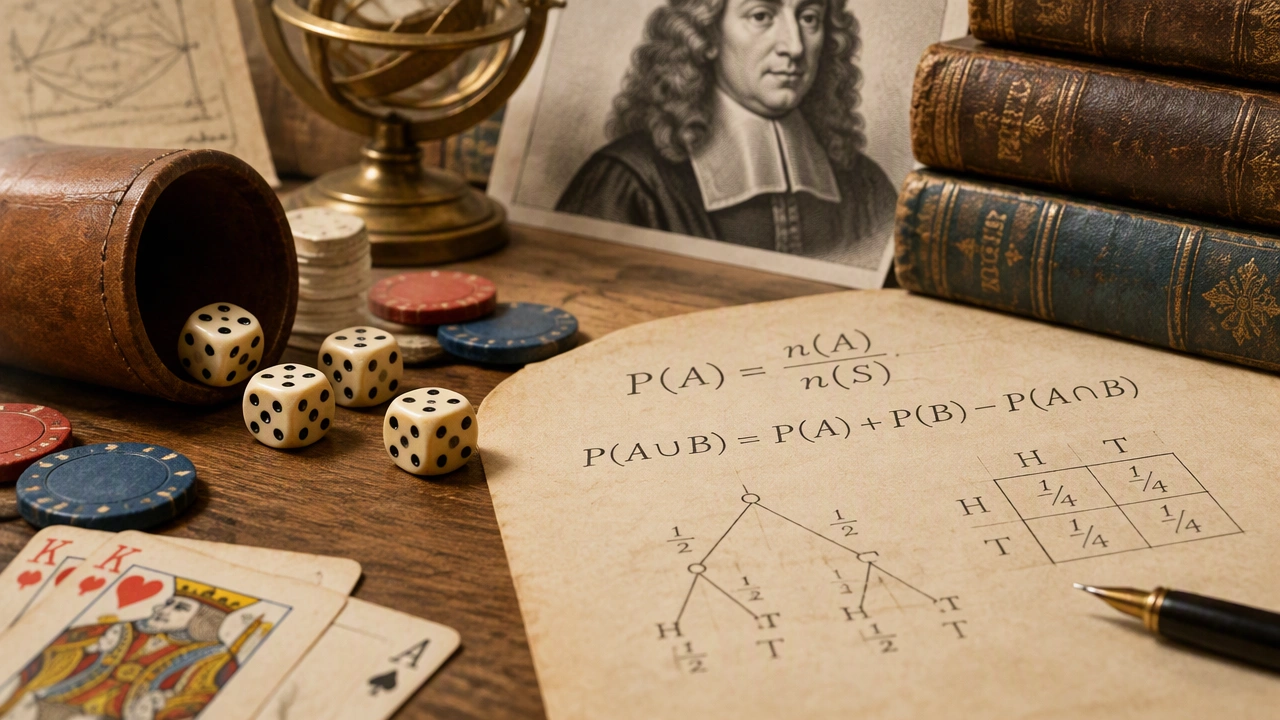
Tracing the Origins of Probability Theory from Gambling Problems to Rigorous Mathematics
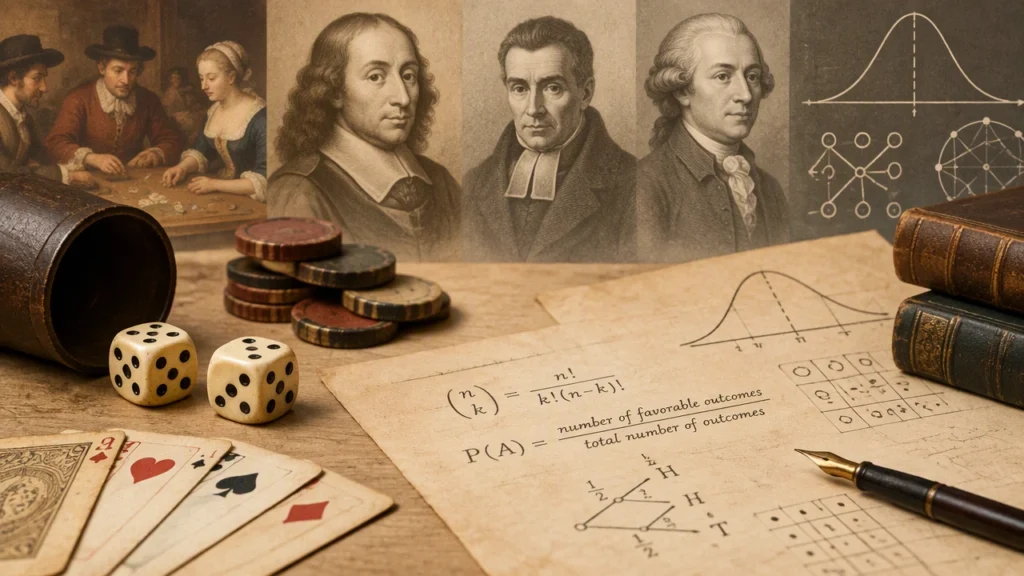
The origins of probability theory in mathematics began with practical puzzles about games of chance, but the subject soon grew into a disciplined way to reason about uncertainty. Probability now supports science, engineering, medicine, artificial intelligence, and everyday forecasts. Its history shows how concrete questions can motivate abstract methods, and how informal intuition can be replaced by precise definitions.
This account is educational. It explains how mathematicians moved from counting favorable cases to building a rigorous framework for random phenomena, without suggesting that anyone gamble or place bets.
Games of chance and the first calculations
In the late sixteenth and early seventeenth centuries, European thinkers encountered recurring questions from card and dice games. Players wanted to know which outcomes were likely, how to divide stakes when a game was interrupted, and how to compare uneven chances. These were not merely leisure questions; they exposed a deeper issue: how can one measure uncertainty when the exact outcome is unknown?
The decisive exchange is often associated with a 1654 correspondence between Blaise Pascal and Pierre de Fermat. They analyzed the problem of dividing stakes fairly when a game stops before completion. Their key insight was to consider all possible continuations, assign each a fair weight, and average the resulting payoffs. This idea introduced a systematic notion of mathematical expectation.
Earlier and contemporary writers also contributed. Cardano, in the sixteenth century, recorded observations about dice and frequencies. Later, Christiaan Huygens produced an influential treatise on reasoning about chance, extending expectation and clarifying how to compare uncertain prospects. The early tradition was combinatorial: count the possible arrangements, identify favorable cases, and form ratios. This approach worked well for small, well-defined settings.
From counting cases to stable laws
As problems grew more complex, mathematicians sought patterns that could predict long-run behavior. Jacob Bernoulli’s work on the law of large numbers addressed a fundamental question: if an experiment is repeated many times, does the observed frequency approach a fixed underlying probability? Bernoulli’s answer required careful reasoning about independence and repeated trials, and it helped connect finite combinatorial calculations with a broader theory of stable averages.
Abraham de Moire introduced important results concerning the normal distribution and approximations to binomial calculations. Later, Pierre-Simon Laplace systematized much of the developing subject and stated a general framework for conditional probability, now known as Bayes’ theorem in its modern form. Laplace used probability to study errors, astronomical measurements, and demographic patterns, showing that the theory could move beyond games into scientific inference.
Probability enters science and statistics
Nineteenth-century researchers applied probability to errors of observation, measurement, and natural variation. Adolphe Quetelet and others used statistical averages to describe social and physical phenomena, although such applications also raised cautions about oversimplifying human behavior. The key advance was the recognition that randomness does not mean complete disorder: regularities can appear in aggregates even when individual events remain unpredictable.
James Clerk Maxwell and Ludwig Boltzmann used probabilistic reasoning in statistical mechanics, describing the behavior of large numbers of particles through distributions rather than exact trajectories. In this setting, probability became a tool for connecting microscopic uncertainty with macroscopic regularity. The same intellectual move appeared in genetics, insurance mathematics, and the analysis of measurement error.
A rigorous foundation
By the early twentieth century, probability needed a clearer foundation. Informal counting and frequency arguments could be powerful, but mathematicians wanted definitions that supported proofs without relying on vague appeals to chance. In 1933, Andrey Kolmogorov published an axiomatic treatment that organized probability around a sample space, a collection of events, and a measure assigning probabilities to those events.
This framework, known as measure-theoretic probability, provided precise language for several central ideas:
- Sample space: the set of all possible outcomes of a random experiment.
- Events: subsets of the sample space to which probabilities are assigned.
- Probability measure: a function that is nonnegative, normalized to one, and additive over disjoint events.
- Random variables: functions that translate outcomes into numerical quantities for analysis.
- Expectation and distribution: tools for summarizing average behavior and long-run frequencies.
With these definitions, mathematicians could prove limit theorems, analyze stochastic processes, and distinguish carefully between different meanings of independence. The axioms did not eliminate uncertainty; they made reasoning about uncertainty logically consistent.
Modern directions and lasting lessons
Twentieth-century probability expanded into stochastic processes, including Markov chains, random walks, and queueing models. These tools describe systems that evolve over time under uncertainty. Probability also became central to statistical inference, where observed data are used to evaluate hypotheses and estimate unknown quantities. In the late twentieth and twenty-first centuries, probabilistic methods grew rapidly in computer science, machine learning, cryptography, and network analysis.
The history of probability offers several educational lessons. First, practical questions can generate profound mathematics: problems about cards and dice led to expectation, independence, and limit laws. Second, intuition must be checked carefully; plausible reasoning about chance can be misleading without clear definitions. Third, probability is not a claim that events are predetermined, nor is it a license for reckless risk-taking. It is a structured language for describing incomplete information.
Today, a weather forecast, a medical test result, or a quality-control chart all rest on ideas developed across centuries. The journey from gambling problems to a rigorous mathematical field illustrates how mathematics grows: begin with a concrete puzzle, search for patterns, formalize the assumptions, and test the resulting theory against new questions. That process turned the study of chance into one of the most useful branches of modern mathematics.